Rumi and Shams-e Tabrizi: The Meeting That Changed Poetry
Discover how a 13th-century meeting with mystic Shams-e Tabrizi turned scholar Rumi into Persia's greatest poet. First in a weekly Persian poetry series.
PERSIAN POETRY
7/10/2026

Long before Ferdowsi's Shahnameh found its way into music, the same Persian literary tradition had already produced another kind of immortality: the mystic poets whose verses are still memorized, sung, and quoted eight centuries later. This is the first post in a weekly series exploring one story or poem from a great Persian poet at a time — and there's no better place to start than with a man who is, by some counts, the best-selling poet in America today: Jalal ad-Din Muhammad, known to the world as Rumi, and to Persians simply as Mowlana, "our master."
Rumi was not born a poet. He was born in 1207 in Balkh, in what is now Afghanistan, and fled west with his family as the Mongol armies swept across Central Asia. The family eventually settled in Konya, in present-day Turkey, where Rumi's father was a respected theologian. Rumi followed the same path — by his late thirties he was a well-regarded Islamic scholar and preacher, running a religious school, exactly the life that was expected of him. Nothing about his first four decades suggested he would become one of history's great poets.
Everything changed in 1244, when a wandering mystic named Shams-e Tabrizi arrived in Konya. The stories of their first encounter have been told so many times they've become legend — in one version, Shams stops Rumi in the street and asks him an unanswerable question about the nature of prophecy; in another, he throws Rumi's books into a fountain and asks, "Can you understand this?", and when Rumi says no, Shams fishes the books out, perfectly dry. Whatever actually happened, the effect was immediate and total. Rumi, the respected professor, withdrew from his students and his public life for months at a stretch simply to be near this strange, uncredentialed wanderer. His own family and followers were scandalized.
The friendship didn't last. Shams disappeared from Konya in 1248 — some say he simply left, others believe he was killed by Rumi's jealous disciples. He was never seen again. What followed was a grief so total that Rumi, by his own account, could not write for a long time. And then, slowly, the grief became verse. At first he wrote in Shams's name, as if the poems belonged to his lost friend rather than to himself. He never really stopped again. Over the following decades he produced the Masnavi, a six-volume poem of some 25,000 couplets that Persian speakers still call "the Quran in Persian," along with tens of thousands of shorter verses, and he inspired the practice that would become known as the whirling dervish ceremony — turning grief itself into a kind of prayer.
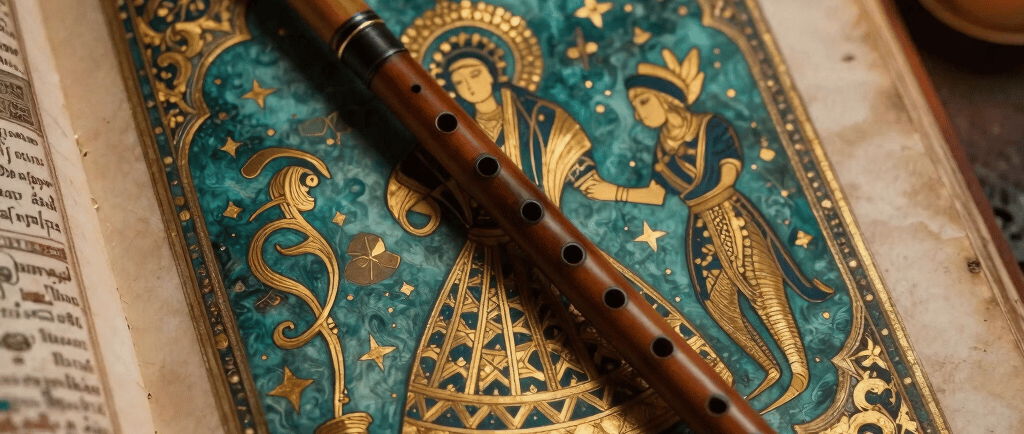
The Masnavi opens with an image that has outlived every empire that rose and fell during Rumi's lifetime: a reed, cut from the reed bed where it grew, made into a flute, and forced to cry out in music because it has been separated from where it belongs. Every note the reed plays, in Rumi's telling, is really a lament for home — and every person who hears it recognizes something of their own longing in that sound, whether they call it the soul's distance from the divine, from a lost home, or simply from the person they used to be. It's one of the most quoted images in Persian literature precisely because it never insists on one meaning. It just asks: what are you separated from, and what does your own life's music say about it?
Ferdowsi and Rumi wrote in different centuries, different genres, and for different reasons — one setting down Iran's mythic history in epic verse, the other turning private mystical experience into lyric poetry two and a half centuries later. But they share the same instinct: that the deepest things — grief, memory, longing, transformation — are best carried by story and by verse, not explained away. That's the same instinct behind this project. If Rostam's trials or Rudabeh's tower speak to you the way Rumi's reed does, you'll find more of that world in our Stories section, and in the album itself.
Next week, we'll turn to Saadi of Shiraz and the garden of stories he called the Golestan — one of the most quietly influential books in Persian literature, and a very different kind of wisdom than Rumi's.